

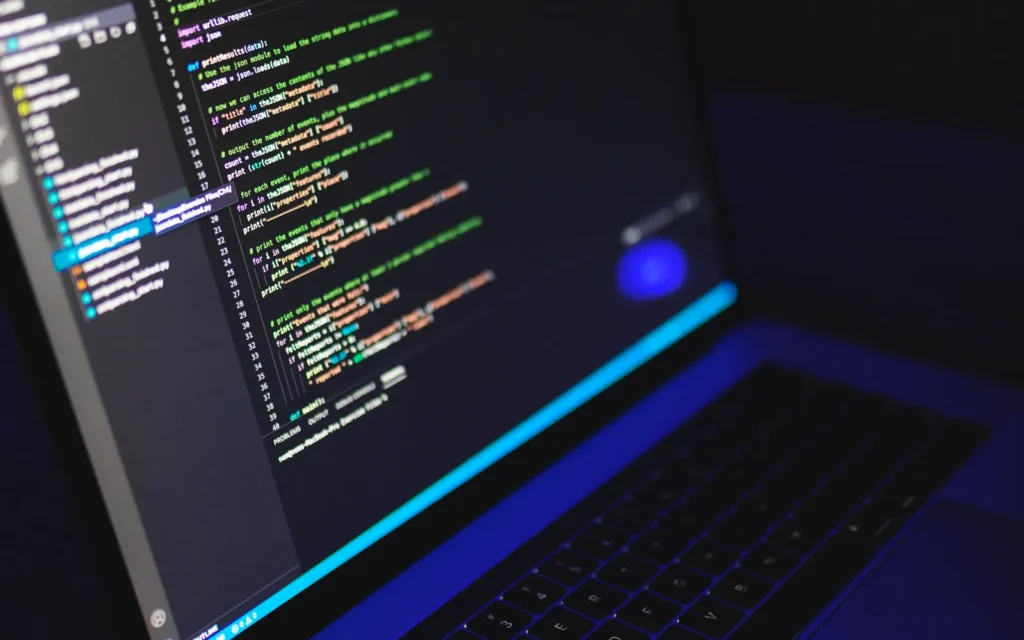
If you have ever wondered what programming actually feels like, Python is the friendliest place to start. It reads almost like plain English, it forgives small mistakes, and it can take you from your very first line of code to building real websites, apps, and tools. In this guide, you will learn exactly what Python is, what it is used for, and how to run your first program in under an hour.
What Exactly Is Python?
Python is a programming language — a way to give instructions to a computer. When you write Python code, you type lines of text that describe what you want the computer to do: add two numbers, show a message on the screen, or open a file and read it. A program called the interpreter reads your code and carries out those instructions.
Python belongs to a family of languages called high-level languages: it hides the complicated details of how a computer’s processor works, so you can focus on solving problems.
Here is a tiny example so you can see how readable it is:
name = input("What is your name? ")
print("Hello,", name)
Even if you have never programmed before, you can probably guess what this does: it asks for your name and greets you. That readability is Python’s superpower.
Who Created Python and Why?
Python was created by Guido van Rossum, a Dutch programmer, and first released in 1991. He was working on a hobby project over the Christmas holidays in 1989 and wanted a language that was easy to read, easy to write, and powerful enough for serious work. He named it after the British comedy group Monty Python, not after the snake — which is why you will sometimes spot Monty Python jokes in official documentation.
The project grew far beyond a hobby. Today, Python is maintained by a huge global community and guided by the Python Software Foundation, a non-profit organization. New versions arrive regularly, and every improvement is discussed openly.
Python is also free and open source: you can download it and use it for any purpose, including commercial work, at no cost.
What Is Python Used For?
One of the best things about Python is its range. The same language that a beginner uses for a first homework exercise is also used by companies like Google, Netflix, and NASA for serious, large-scale work. Here are the main areas:
Web Development
Python powers the server side of many websites — the part that runs behind the scenes, handles your login, and fetches data from a database. Frameworks like Django and Flask give you ready-made building blocks so you do not start from zero. Instagram’s backend, for example, famously runs on Django.
Data Science and Machine Learning
Python is the most popular language for working with data. Libraries like pandas, NumPy, and scikit-learn let you analyze spreadsheets with millions of rows, and tools like TensorFlow and PyTorch are used to build machine learning models — the same kind of technology behind recommendation systems and image recognition.
Automation and Scripting
Boring, repetitive computer tasks are Python’s favorite snack. Renaming hundreds of files, scraping information from a website, sending a daily email report, or backing up folders can all be automated with short scripts. Many people learn Python specifically to make their office work less tedious.
Other Uses
Python also shows up in game development (with libraries like Pygame), scientific research, network programming, desktop applications, and even in controlling hardware like the Raspberry Pi. If a task involves a computer, there is a good chance Python can help with it.
Why Is Python Great for Beginners?
There are hundreds of programming languages, so why does almost every “learn to code” guide mention Python first? A few solid reasons:
- Simple, readable syntax: Python code looks like sentences. You do not need semicolons at the end of every line or curly braces everywhere, which removes a lot of beginner frustration.
- Huge community: If you get stuck, someone has almost certainly asked your exact question online. Answers, tutorials, and free courses are everywhere.
- Forgiving errors: When something goes wrong, Python’s error messages usually point to the exact line and explain what it expected, which makes debugging much less scary.
- Fast to see results: You can write three lines and have a working program. That quick feedback keeps motivation alive in the early weeks.
- Real career value: Unlike some “teaching-only” languages, Python is used professionally. The skills you build transfer directly to jobs.
To see the difference syntax makes, compare printing text in Python with a more verbose language like Java:
# Python
print("Hello, world!")

// Java
public class Main {
    public static void main(String[] args) {
        System.out.println("Hello, world!");
    }
}
Both do the same thing, but Python needs just one line — less typing means fewer places to make mistakes while you are learning.
Installing Python on Your Computer
Getting Python running takes only a few minutes. Here is how on each major system:
- Windows: Go to python.org, click Downloads, and run the installer. On the very first screen, check the box that says “Add python.exe to PATH” — this is important, because it lets you run Python from any folder. Then click “Install Now”.
- macOS: Visit python.org and download the macOS installer, or install it with the Homebrew package manager using
brew install python3in the Terminal. - Linux: Python usually comes pre-installed. Open a terminal and type
python3 --version. If you see a version number like 3.11 or higher, you are ready.
After installing, open a terminal (Command Prompt on Windows) and type:
python --versionIf it prints something like Python 3.12.4, your installation worked. On macOS and Linux you may need to type python3 --version instead.
For writing code, grab a free editor like VS Code or Thonny (made for learners).
Your First Python Program
Let us write a real program together. Open your code editor, create a new file called hello.py, and type this:
# My first Python program
name = input("What is your name? ")
age = int(input("How old are you? "))

next_year = age + 1
print("Nice to meet you,", name + "!")
print("Next year you will be", next_year, "years old.")
Save the file, then run it from your terminal:
python hello.pyThe program will ask for your name and age, then do a small calculation and print a friendly message. Congratulations — you just wrote a program that takes input, stores it in variables, converts text to a number with int(), does arithmetic, and produces output. Those five ideas — input, variables, conversion, calculation, output — are the foundation of almost every program you will ever write.
A few notes on what you just saw:
- Lines starting with
#are comments — notes for humans that Python ignores. input()reads text the user types. It always gives you a string, which is why we wrapped the age inint()to turn it into a number.- Indentation (spaces at the start of lines) matters in Python. It is how Python knows which lines belong together.
Key Concepts You Will Meet Next
As you continue learning, you will keep running into these ideas. You do not need to master them today — just recognize the names:
- Variables and data types: containers holding numbers (
int,float), text (str), and true/false values (bool). - Lists and dictionaries: collections of items — a list keeps things in order (
["apple", "banana"]); a dictionary pairs keys with values ({"name": "Sara"}). - If statements: let your program make decisions — “if the password is correct, let the user in.”
- Loops: repeat actions without rewriting code, using
forandwhile. - Functions: named, reusable blocks of code defined with
def. - Modules and libraries: extra code collections you can import — Python ships with dozens built in.
Here is one more example that uses a loop and an if statement, so you can see how these pieces fit:
for number in range(1, 11):
    if number % 2 == 0:
        print(number, "is even")
    else:
        print(number, "is odd")
Common Beginner Mistakes (and How to Avoid Them)
Every beginner hits the same few bumps. Knowing them in advance saves you hours:
- Indentation errors: Mixing tabs and spaces, or indenting inconsistently, causes an
IndentationError. Pick one (spaces are standard — four per level) and stick with it. - Forgetting that input() returns text: Trying
age + 1whenageis still a string gives aTypeError. Convert withint()orfloat()first. - Typos in variable names: Python treats
Nameandnameas different variables, because it is case-sensitive. Copy names exactly. - Not reading the error message: The last line of a Python error usually tells you exactly what went wrong. Read it before changing anything.
- Trying to learn everything at once: Master variables, input/output, and if-statements first; advanced topics can wait.
Final Thoughts
Python is popular for a simple reason: it lets you think about problems instead of punctuation, and it grows with you from tiny scripts to professional software. You now know what Python is, what it is used for, and how to run your first program.
Your suggested next steps: first, make sure Python is installed and run the hello.py program above. Second, experiment — change the messages and break things on purpose to see what the errors say. Third, move on to variables and data types to deepen your foundation. Even twenty minutes of daily practice will compound into real skill within a few weeks.
